THE SOLDIER STRING QUARTET
ABOUT
We were called, and then called ourselves, “The Ramones of classical music.” Active 1985–1995, and we now very occasionally reconvene for recording sessions and shows with rock groups (over the past few years for Van Dyke Parks, Jessie Harris, Guided by Voices, and Lambchop).
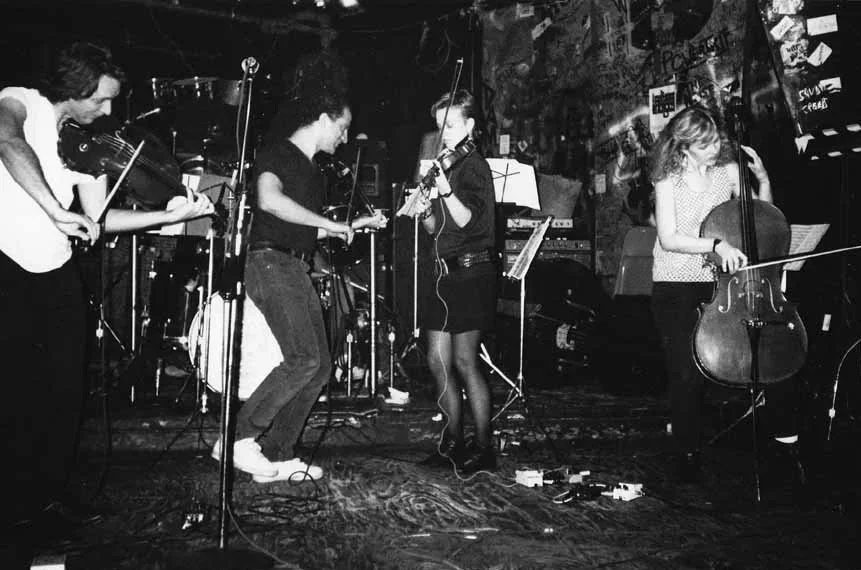
Inspired by the Concord Quartet and the Beastie Boys, we performed at rock clubs like CBGBs and experimental festivals in Europe using a drummer and electricity. We stood to play and memorized the music, and would stamp around like punk rock and hiphop groups; we occasionally played at Lincoln Center and normal places for chamber groups.
My works for quartet are highly syncopated and contrapuntal with ideas from rock, R&B, and blues as well as the European tradition. We performed my arrangements of originally unnotated music, like Delta Blues and Sly Stone, and presented new composed music by a broad range of composers, premiering over 100 compositions.
We toured as John Cale's “band” from 1992–1998 playing my arrangements of his songs, often with BJ Cole on steel guitar.
We also worked with Teo Macero, Amina Claudine Myers, Leroy Jenkins, Tony Williams, Van Dyke Parks, Guided by Voices, Ric Ocasek (the Cars), Bob Neuwirth, Robert Dick, Jessie Harris, Lee Renaldo (Sonic Youth), Shelley Hirsch, Joanne Brackeen, Elliot Sharp, Zeena Parkins, Fred Frith, Myra Melford, Lenny Pickett, Jonas Hellborg. For a couple of seasons we were the quartet for the American Festival for Microtonal Music and premiered works in the “chamber” vein by Iannis Xenakis and Ivan Wyshnedgradsky.
HISTORY
I always loved syncopation and counterpoint, as a child from funk and rhythm and blues, later in medieval and baroque music, salsa and flamenco. I've tried various ways to design overlapping rhythms, influenced by theorists Bernard Ziehn Josef Schillinger, Heinrich Schenker, and by figuring out how syncopations arise in R&B, salsa, and flamenco. I was really moved by Conlon Nancarrow and Gyorgi Ligeti's piano pieces, and tried to find a different path than what they explored. Nancarrow was particularly inspiring.
The Soldier String Quartet let me explore new rhythm juxtapositions, and I started it in 1985 because string players could read harder rhythms that guitarists, because I was going through a Haydn worship phase, because I played the violin, and because the string quartet seemed so quaint that the idea was funny.
We introduced/experimented with amplification, moving around on stage (inspired by the Beastie Boys and gospel music), memorizing the parts, and playing American rhythms. I put in a lot I learned from playing in rock and R&B bands, using a drum kit to help rhythmic polyphony, and I wrote the drum parts: fortunately Michael Suchorsky, long-time drummer for Lou Reed and Everyman Band, is the rare drummer who can play written parts and make them sound natural.
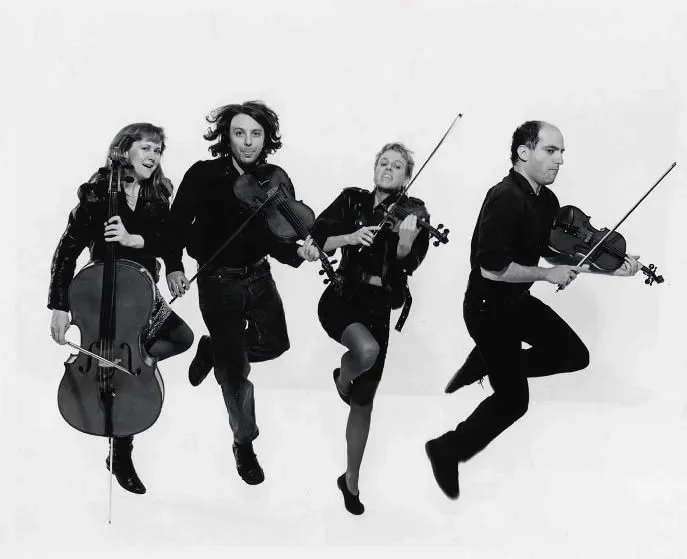
The original group was Laura Seaton and me on violins, Drew Tretick on viola, Jane Scarpantoni on cello, Bruce Ditmas on drums. We soon added Ratso Harris on bass, and Ron Lawrence joined on viola, Mary Wooten on cello, and Michael Suchorsky on drums. Around 1992 Regina Carter joined on violin followed in 1996 Todd Reynolds, and Martha Mooke and Judith Insell on viola, and Dawn Avery on cello. Around 1992 we added two singers, especially on tours, Tiye' Giraud and Jason White, and after Jason suddenly and shockingly passed at the age of 23, Sam Butler from the Five Blind Boys of Alabama and later Jimmy Justice would sing. Jimmy also passed away in 2008.
In the early 90's we would often tour Europe with the two singers and four strings, as the group or on a package with John Cale. At various times and projects other players included Lisa Terry, Mark Feldman, and Marlene Rice on violin, Mark Dresser, Kermit Driscoll, and Richard Bona on bass, Kevin Norton and Samm Bennett on drums. We collaborated a lot with Elliott Sharp, Robert Dick, Nicolas Collins and John Cale, and occasionally with Teo Macero, Amina Claudine Myers, the American Festival of Microtonal Music, and many others.
One project I plan to finish is a cycle of full “string quartets” I began with Quartet #1, The Impossible, which is recorded on Sojourner Truth. I wrote a Quartet #2, Bambatta Variations, especially for a surreal quartet built by Ken Butler out of found object but that can be played using normal techniques; we premiered it at Merkin Hall but never recorded it. I've also written in part Quartet #3, The Essential, based on the idea that you boil down a regular quartet and display it as a Wester blot, a way biologists indicate protein makeup of a cell and get at its “essence” — the music is highly syncopated and an odd twist to Schoeberg's second quartet; it was very hard but was premiered in 2009 at the Issue Project Room in Brooklyn, with the players wearing EEGs.
Beyond my own compositions for the quartet, I always asked composers who presumably would never otherwise write music for a string quartet to do so. We premiered many works by Elliott Sharp, and pieces by Leroy Jenkins, Fred Frith, Phill Niblock, David Linton, Zeena Parkins, Nicolas Collins, Jonas Hellborg (with Tony Williams on drums!), Van Dyke Parks, and many others that I will add when I go through my notes.
The other goal is to arrange polyrhythmic music that had not been notated. I figure it out as well as I can, and force the players listen to the originals for phrasing — that's hard with classical freelancers! We started with Delta Blues on our first LP by Muddy Waters, Skip James, and Robert Johnson. Trying to listen very carefully helped me develop a style, and helped the group phrase in American music. We released a live album of blues arrangements from Art at St. Ann's. I expanded arrangements to pieces by Sly Stone, Jimi Hendrix, Earth Wind & Fire, Tito Puente, and lots of others. We made two CDs of my arrangements for quartet with the trailblazing flutist Robert Dick, one of Jimi Hendrix pieces, and the other of lesser known jazz pieces by Eric Dolphy, Wayne Shorter, John Coltrane, and Ornette Coleman.
I arranged Paris 1919 by John Cale, whose music I identified with in high school as someone else who didn't differentiate “classical” and “pop” styles; John heard it and the Quartet became his backup group from 1992–96. This led to the quartet playing and/or arranging for a lot of great pop groups and producers, including Guided by Voices, David Byrne, Ric Ocasek, Lambchop, Van Dyke Parks, Jessie Harris, Bill Laswell, Lee Renaldo and not least, Teo Macero.
One highlight in this direction was with Cale in 1993 at NYU where Lou Reed and Sterling Morrison showed as a first surprise reunion of the Velvet Underground — John asked me to arrange some old tunes and some from his recent duo with Reed, but wouldn't tell me why — though Mo Tucker missed her train and didn't get to the concert in time, which prevented it from being the “complete” reunion concert.