Composer, multi-instrumentalist, and neuroscientist Dave Soldier connects sound, science, and the natural world.
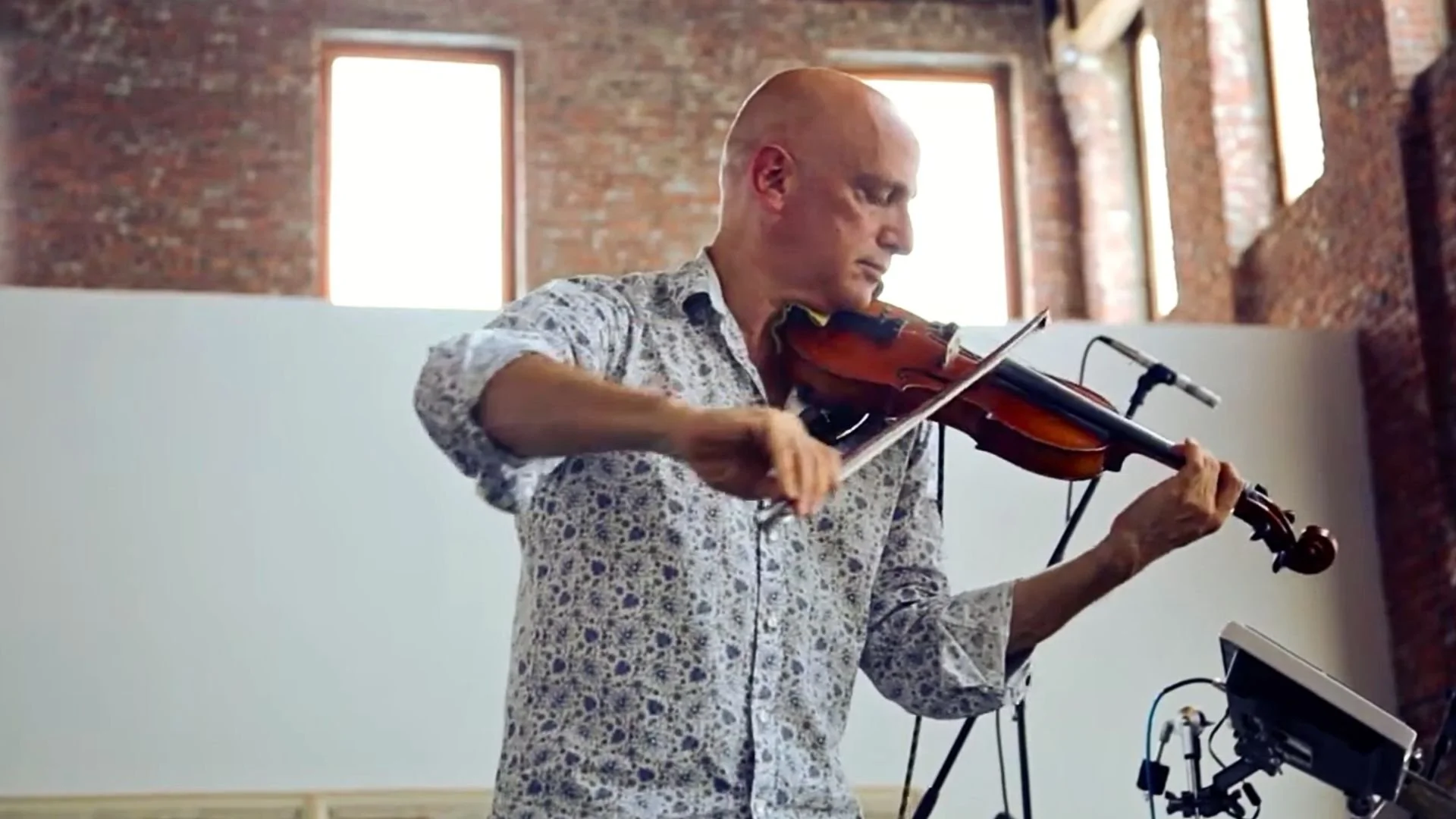
“Dave Soldier is an iconoclast, trying to expand our idea of what music can be.”
– The New Yorker
BIOGRAPHY
Dave Soldier (born David Sulzer) leads a double life as a musician and a neuroscientist. He played the violin and guitar while growing up in Minnesota, Illinois, and Connecticut, and, as a teenager, began touring with country, rock, rhythm, western swing, and blues bands. He attended Michigan State, where he studied plant genetics while studying composition privately with Roscoe Mitchell. He studied plant breeding at the University of Florida and played guitar in rhythm-and-blues groups, including with Bo Diddley, before moving to New York City in 1981, where he studied with Otto Luening and performed in salsa, experimental, and classical groups while pursuing a Ph.D. in biology at Columbia University. While there, he studied composition privately with Otto Luening and at night at the Juilliard School. As his contemporary music group, the Soldier String Quartet, became better known, he changed his musical name to Dave Soldier to avoid being thrown out of graduate school.
In 1985, he founded the seminal punk chamber group, the Soldier String Quartet, which pioneered the fusion of classical, punk rock, R&B, and hip-hop styles, performing at venues ranging from CBGBs to Carnegie Hall and Lincoln Center and premiering over 100 compositions by composers including Teo Macero, Leroy Jenkins, Phill Niblock, Zeena Parkins, Fred Frith, Terry Riley, Elliott Sharp, Alvin Curran, Charles Mingus, and Ivan Wyschnegrasky. The group recorded with many rock, pop, and jazz artists including Guided by Voices, John Cale, Rufus Wainwright, Lee Ranaldo, Van Dyke Parks, Tony Williams, Jonas Hellborg, and Bill Laswell, and served as a training ground for performers including Regina Carter and Todd Reynolds. He also founded the Memphis/New York Delta punk band The Kropotkins, a cult favorite featuring Lorette Velvette and Mo Tucker of the Velvet Underground.
As a performer, arranger, and producer, Soldier has worked across pop, jazz, experimental, world music, and classical traditions with artists including John Cale and each member of the Velvet Underground, Bo Diddley, David Byrne, Ric Ocasek, Pete Seeger, Marshall Allen, Kurt Vonnegut, and many others, appearing on over 100 albums and films on violin, guitar, or as an arranger. He arranged scores for films including Eat and Kiss, I Shot Andy Warhol, and Basquiat, and composed music for television including Sesame Street, as well as the silent film/theater work The Violinist.
As a composer, Soldier’s work ranges from solo pieces to chamber music, orchestral works, song cycles, oratorios, and two operas, Naked Revolution and The Eighth Hour of Amduat. His album Chamber Music was named by the New York Times as one of the top classical recordings of the year. His compositions have been performed and recorded by ensembles and artists including the Manhattan Chamber Orchestra, the Absolut Ensemble, PUBLIQuartet, Curtis Stewart, The Prague Filmharmonic Orchestra, Miranda Cuckson, Regina Carter, Rebecca Cherry, Erik Friedlander, Eliza Carthy, Shelley Hirsch, Amina Claudine Myers, William Schimmel, Steven Beck, Christopher O’Riley, Geoffrey Burleson, Marshall Allen (leader of the Sun Ra Arkestra) and Robert Dick. His collaborations include song cycles and oratorios with Kurt Vonnegut, arrangements for John Cale, David Byrne, and Guided by Voices, and numerous works for classical and jazz musicians.
Many of his projects are unusual collaborations that bridge disciplines, cultures, and species. He co-founded, with conservationist Richard Lair, the Thai Elephant Orchestra, consisting of 14–16 elephants in Northern Thailand for whom he built giant musical instruments, and which released three CDs. He has coached children to compose their own music in Harlem (Da Hiphop Raskalz), Brooklyn (the Tangerine Awkestra), Washington Heights, and northern Guatemala (Yol Ku: Mayan Mountain Music). His work includes The People’s Choice Music: the most wanted and unwanted songs, based on poll results of American musical preferences, created with artists Komar & Melamid. He has also created music performed on specially designed instruments by songbirds and bonobos, and music performed by electrical brain activity in the Brainwave Music Project with Brad Garton, which has been featured on PBS and BBC. With chemist Roald Hoffmann, he has presented the science-and-art series Entertaining Science, and has developed compositions using mathematical transformations including fractals, calculus, and Fourier processes.
As David Sulzer, he is a neuroscientist and Professor at Columbia University in the Departments of Psychiatry, Neurology, and Pharmacology. His laboratory investigates the synapses of the cortex and basal ganglia, including the dopamine system, and their roles in habit formation, planning, and decision-making. His work has made major contributions to understanding the action of addictive drugs and the causes of diseases including Parkinson’s, Huntington’s, and autism. His lab developed the first methods to directly measure quantal neurotransmitter release and the first optical methods to visualize neurotransmission at the synaptic level using fluorescent false neurotransmitters. He founded the Dopamine Society and the Gordon Conference on Parkinson’s Disease, and has published widely in journals including Science and Nature, with over 70,000 citations.
A few projects unite his work in music and science. With Brad Garton, he initiated the Brainwave Music Project, enabling musicians to perform using brain activity while teaching audiences about the nervous system. His book Music Math and Mind, on the physics and neuroscience of music, was published by Columbia University Press in 2021. Across his career, Dave Soldier has worked as a composer, performer, scientist, collaborator, and educator, creating work that spans classical, experimental, popular, and scientific domains.